Local body election results across states reaffirm that the NDA continues to penetrate and dominate Indian politics at the grassroots. The Prime Minister’s popularity, the government’s decade-long record, and the opposition’s inability to align with public aspirations are widely acknowledged. Supporters and critics alike agree on one point: the NDA delivers on its manifesto and remains unwavering in its Viksit Bharat commitment.
The Development–Environment Contradiction
Here lies the non‑political dilemma that no party or narrative can escape. Every developing economy faces it. The demands of 150 crore Indians, combined with the development model we have adopted, collide with the environmental pillars essential to the 2047 vision. Forest conservation and expansion, forest governance, biodiversity protection, community‑centric forest management, climate‑resilient infrastructure, and urban air‑quality improvement are the areas where India is expected to advance — yet the gap between expectation and reality is widening.
Visible Ecological Decline
Declining forest cover, rising human–wildlife conflict, and deteriorating urban air quality are now everyday observations, obvious even to schoolchildren. Government action has been largely symbolic — speeches, research notes, photo‑op plantations, and isolated improvements — while several decisions actively undermine environmental protection. A Chief Minister boasts of clearing Aarey forest in a day; a minister proposes cutting 1,800 trees in the name of religiosity; protected zones are routinely de‑notified; mangrove lands are appropriated; and a Union minister seeks to dilute the Aravalli definition through selective “expert” inputs. These are not lapses but regressions.
A Vacuum in Political Accountability
The opposition, weakened by credibility issues and narrow politics, fails to capitalise on these environmental failures. Into this vacuum step volunteers, citizen groups, green activists, and litigants — many of whom become targets of fabricated narratives even as they persist in their efforts.
The Environment’s Own Battle Cry
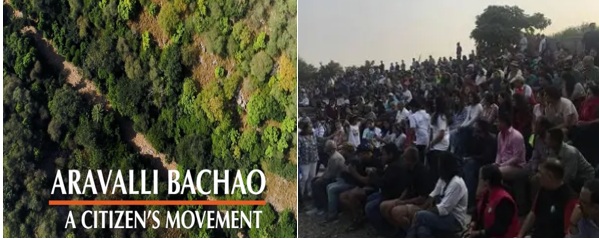
These voices, though faint, are beginning to be heard — amplified not only by activism but by the environment itself. Ecological stress signals are becoming louder than political rhetoric. The battle cry is no longer from environmentalists alone; it is from the environment itself. It is not the battle of the Delhi NCR region for quality of air, it is the battle of Aravali itself.
 Bol Madhavache
यावर आपले मत नोंदवा